This is a Consultancy service on Supply Chain management, Visual Assistance, Blockchain Node Consulting, IT Assistant and NFT Minting
Aim: To Advertising Cultural Arts and Crafts.
we do Small fraction of a work to contribute to the welfare of the society.
we have a vision of making every person in PNG to have a piece of pi
" GET SMARTER WITH DIGITALISATION"
⚡♾️⚛️
Disclaimer
The Information user in this site is not a financial advice. For more details seek a legal Authorities for additional information.
The Information published in this article is only for Educational purpose and has no Affiliation with the Financial Institutions or Organisation.
Please be caution Of Hacks and Scammers.
WANT TO BE ON THE SAFE SIDE SUBSCRIBE TO MY SITE AND FOLLOW MY OFFICIAL SOCIAL MEDIA CHANNEL.
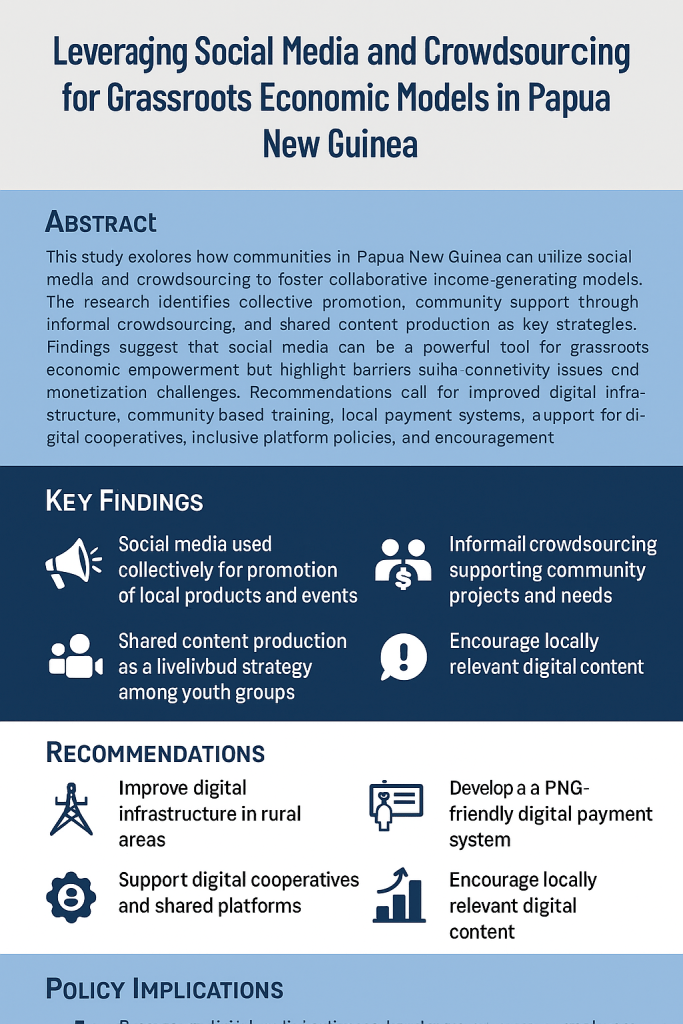
This research explores how communities in developing countries like Papua New Guinea (PNG) can leverage social media and crowdsourcing as tools for building sustainable grassroots economic models. The paper investigates how collective digital labor, facilitated through platforms such as Facebook, TikTok, and YouTube, can enable local income generation and social innovation. Drawing on qualitative data, the study applies theoretical frameworks such as the Bottom of the Pyramid (BoP), Social Capital Theory, and Platform Economy Theory to examine the interplay between community collaboration and digital participation. The findings indicate that when individuals combine their digital efforts and skills within a community-centered framework, they can amplify their online presence and economic impact. The paper concludes by offering policy recommendations aimed at fostering inclusive digital economies in PNG and similar contexts.
Keywords: Papua New Guinea, social media, crowdsourcing, grassroots economy, digital inclusion, collective digital labor, platform economy, economic development
Introduction
As digital technology continues to shape global economic landscapes, developing nations like Papua New Guinea (PNG) are presented with both opportunities and challenges. While much attention has been given to formal sectors and infrastructure-based development, grassroots communities in PNG are increasingly finding ways to engage with digital tools—particularly social media platforms and crowdsourcing networks—as means of economic participation. These platforms offer accessible, low-barrier environments where individuals can showcase talents, mobilize collective efforts, and generate income.
Papua New Guinea presents a unique case study due to its rich cultural diversity, strong communal traditions, and growing digital penetration despite infrastructural limitations. In rural areas, traditional economic models often struggle to generate sustainable livelihoods, but social media has opened up new channels for creativity, entrepreneurship, and collaboration. This paper explores how these communities utilize collective digital labor and social networks to generate income and build economic models rooted in grassroots collaboration.
The central hypothesis of this research is that communities in PNG can strategically harness digital tools to overcome geographic, financial, and systemic barriers to economic participation. By investigating these grassroots strategies, the research contributes to the broader discourse on inclusive digital economies in the Global South (World Bank, 2020).
Literature Review
Existing literature on digital economies in developing countries highlights the transformative potential of information and communication technologies (ICTs). Prahalad (2005) argues that the Bottom of the Pyramid (BoP) segment represents a fertile ground for innovation, entrepreneurship, and scalable business solutions that can address poverty. BoP theory posits that low-income populations are not passive recipients of aid but active economic agents who can innovate when given the right tools and market access.
In parallel, sociologists such as Putnam (2000) and Bourdieu (1986) emphasize the role of social capital in facilitating collective action and community resilience. Social capital—the networks of relationships, shared norms, and trust that bind communities—has been shown to enhance cooperation and economic outcomes, especially in settings where formal institutions are weak.
Research on crowdsourcing indicates that decentralized, collective labor can generate meaningful outcomes, particularly when aligned with shared community values (Howe, 2006). Crowdsourcing not only allows for the pooling of ideas and labor but also democratizes participation in economic and social projects. However, critiques from platform economy theorists like Srnicek (2017) caution that digital platforms often replicate global inequalities, limiting opportunities for those in the Global South. These platforms are designed to extract data and labor from users, often with little regard for equitable compensation or access.
Nevertheless, literature also highlights that users in underrepresented regions often develop “creative resistance”—tactics to navigate, adapt, and subvert platform limitations. This paper aims to bridge these perspectives by focusing on how communities in PNG are negotiating these dynamics through localized, collective engagement.
Theoretical Framework
The study draws on three complementary theories to frame its analysis:
Bottom of the Pyramid (BoP) Theory – Developed by C.K. Prahalad, this theory emphasizes the economic potential of low-income communities. It advocates for innovative business models that engage the poor not just as consumers, but as entrepreneurs, producers, and collaborators.
Social Capital Theory – As articulated by Putnam and Bourdieu, this theory explains how networks of trust, norms, and social ties influence cooperation. In PNG, where communal living and the wantok system dominate, social capital is a major determinant of collective economic behavior.
Platform Economy Theory – This theory examines how digital platforms operate as intermediaries between producers and consumers. It critiques the exploitative structures of platform capitalism and highlights the risks of dependency on corporate-controlled ecosystems (Srnicek, 2017).
Together, these frameworks offer a lens through which to understand how grassroots communities are adapting digital tools to local realities and collective goals.
Methodology
This research employed a qualitative, exploratory approach to understand the role of social media and crowdsourcing in grassroots economic development in PNG. Given the contextual complexity and the exploratory nature of the topic, qualitative methods allowed for in-depth insights into participant experiences, motivations, and challenges.
Data were collected through semi-structured interviews with 20 individuals across five provinces in PNG who were involved in digital content creation, online fundraising, or social media-based small enterprises. Additional data sources included observations of online community pages, participatory content, and analysis of relevant public digital posts on platforms like Facebook, TikTok, and YouTube.
Participants were selected using purposive sampling to ensure a diverse representation of age, gender, geography, and digital activity level. Interviews were transcribed and thematically coded using NVivo software. Ethical considerations were observed, including informed consent, confidentiality, and respect for local cultural norms.
Findings/Results
The study identified several key themes across participant narratives and digital activities:
Digital Collaboration: Many participants operated in teams, sharing equipment like smartphones and editing tools to create videos, manage pages, and post content. These digital collectives often formed organically through social ties and shared interests.
Monetization through Community Support: Direct monetization via platforms was limited due to infrastructure and policy barriers, but many participants received donations, local sponsorships, or sales through peer-to-peer interactions.
Use of Wantok Networks Online: Offline social systems extended into digital spaces. Wantoks frequently liked, shared, and promoted each other’s content, creating a virtuous cycle of support.
Challenges in Infrastructure and Payments: Limited internet access, data costs, and the absence of compatible digital payment systems were significant barriers. Participants also expressed frustration with content moderation and visibility algorithms that favored users from high-income regions.
Despite these challenges, participants expressed optimism and described digital engagement as a pathway to both individual and collective empowerment.
Discussion
The findings of this study demonstrate that social media and crowdsourcing when approached through collective action, offer promising avenues for grassroots economic empowerment in PNG.
1. Reinterpreting the BoP in PNG’s Context Unlike traditional BoP models that focus on product delivery to the poor, the PNG context involves co-creation, where communities are not passive recipients but active producers of content, culture, and value. Digital tools enable marginalized groups to participate in a more dynamic and reciprocal economic system.
2. Social Capital as a Digital Lever The strength of PNG’s communal traditions translates into digital environments. Trust, reciprocity, and mutual aid remain central. These social values enhance the sustainability of online initiatives and allow communities to overcome resource constraints.
3. Navigating the Platform Economy While platforms impose structural inequalities, PNG communities exhibit creative resistance by forming local networks, reusing content, and prioritizing mutual growth over individual gain. This form of digital solidarity offers a compelling model of resilience and adaptability.
Conclusion
This study shows that social media and crowdsourcing can be harnessed to build grassroots economic models in PNG, especially when grounded in collective effort and local culture. Despite limited infrastructure and platform barriers, communities are finding innovative ways to collaborate and generate income. These grassroots models challenge dominant narratives about digital exclusion and highlight the agency and creativity of people at the margins of the global digital economy.
Recognizing and supporting these efforts can lead to more inclusive and sustainable digital economies in the Global South. Future research should further explore gender dynamics, long-term impact, and platform-specific strategies in other regions of PNG.
Recommendations
Improve Digital Infrastructure: Expand rural internet access and subsidized connectivity.
Community-Based Digital Training: Offer localized training in digital content, entrepreneurship, and security.
Local Digital Payment Systems: Integrate mobile wallets with global monetization tools.
Support Digital Cooperatives: Provide grants and legal recognition to digital teams.
Platform Policy Advocacy: Advocate for inclusive rules and representation on major platforms.
Encourage Local Content: Invest in cultural and educational content creation programs.
Policy Implications
Recognize digital inclusion as a development priority.
Adapt economic policy to include informal digital innovators.
Reform financial systems to support digital income flows.
Build regional advocacy alliances to engage platform providers.
Design development initiatives that respect and integrate local social capital.
References Bourdieu, P. (1986). The forms of capital. In J. Richardson (Ed.), Handbook of theory and research for the sociology of education (pp. 241–258). Greenwood.
Prahalad, C. K. (2005). The fortune at the bottom of the pyramid: Eradicating poverty through profits. Wharton School Publishing.
Putnam, R. D. (2000). Bowling alone: The collapse and revival of American community. Simon & Schuster.
Srnicek, N. (2017). Platform capitalism. Polity Press.
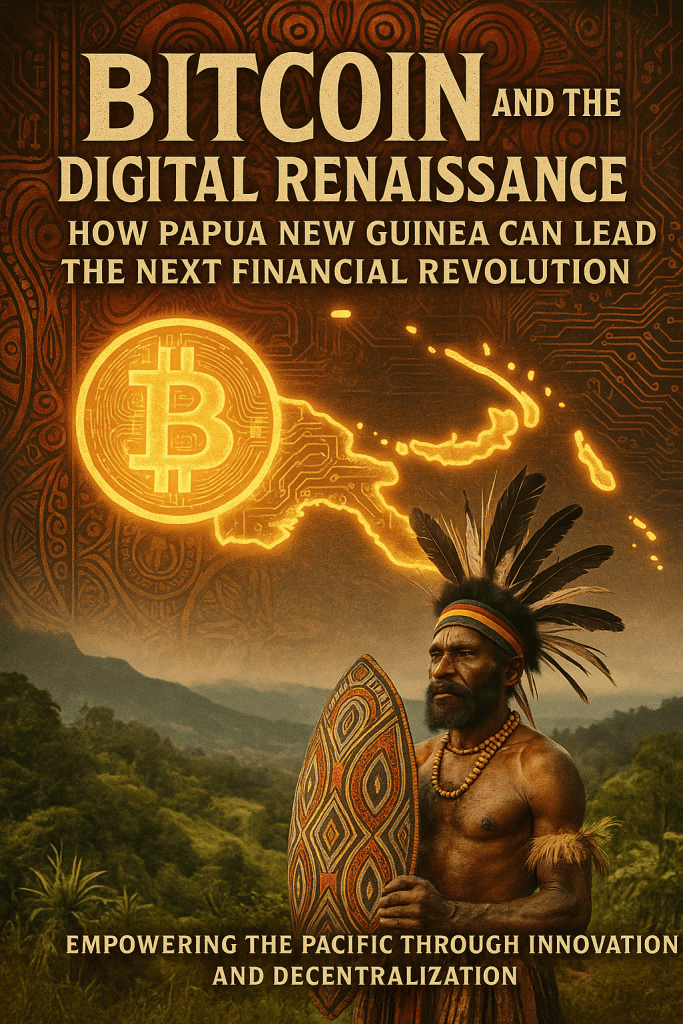
Papua New Guinea (PNG) stands at a pivotal juncture in its economic evolution. The global shift towards digital assets, particularly Bitcoin, offers PNG an opportunity to enhance financial inclusion, stabilize its economy, and integrate into the burgeoning digital economy. This comprehensive overview delves into the historical context of cryptocurrencies, the technological advancements, governance models, and the potential benefits for PNG.
I. Historical Context of Cryptocurrency: From Concept to Reality
Early Foundations
The conceptual underpinnings of digital currencies trace back to the 1980s and 1990s with the emergence of ideas like David Chaum’s DigiCash and Wei Dai’s b-money. These initiatives aimed to create secure, anonymous digital payment systems but lacked the technological framework to prevent issues like double-spending.
The Emergence of Bitcoin
In 2008, an individual or group under the pseudonym Satoshi Nakamoto published the Bitcoin whitepaper, introducing a decentralized digital currency that operates without a central authority. The Bitcoin network commenced in January 2009 with the mining of the genesis block, embedding a message referencing the financial crisis: “The Times 03/Jan/2009 Chancellor on brink of second bailout for banks.” This highlighted Bitcoin’s intent to offer an alternative to traditional financial systems .
Evolution of Blockchain Platforms
Building upon Bitcoin’s foundation, Ethereum was proposed by Vitalik Buterin in 2013 and launched in 2015. Ethereum introduced smart contracts, enabling decentralized applications (dApps) beyond mere financial transactions . Other platforms like Solana have since emerged, focusing on scalability and speed to support a wide array of decentralized services.
II. Bitcoin’s Economic Framework: Tokenomics and Governance
Supply and Distribution
Bitcoin’s supply is capped at 21 million coins, with approximately 19.5 million already mined as of early 2024. The issuance rate halves every 210,000 blocks, roughly every four years, to control inflation .
Governance Model
Bitcoin operates as a decentralized autonomous organization (DAO), where changes are proposed through Bitcoin Improvement Proposals (BIPs). Consensus is achieved via community discussions, miner signaling, and user-activated soft forks, ensuring that no single entity controls the network .
III. Global Adoption and Institutional Recognition
Governmental Engagement
In March 2025, U.S. President Donald Trump signed an executive order to establish a strategic Bitcoin reserve, signaling a significant governmental endorsement of cryptocurrency .
Corporate and Institutional Investment
Major corporations and financial institutions have integrated Bitcoin into their portfolios. For instance, BlackRock recommended allocating up to 2% of investment portfolios to Bitcoin, reflecting growing institutional confidence in digital assets .
IV. User-Centric Innovations: The Case of Pi Network
Pi Network represents a shift towards accessible cryptocurrency mining, allowing users to mine coins via mobile devices without extensive technical knowledge or significant energy consumption. This model democratizes access to digital assets, particularly benefiting individuals in regions with limited technological infrastructure.
Educational and Financial Empowerment
By engaging with Pi Network, users gain exposure to blockchain technology and digital finance, fostering financial literacy and digital skills. This is particularly impactful for youth and unbanked populations in developing regions, providing them with tools to participate in the digital economy .
V. Strategic Implications for Papua New Guinea
Enhancing Financial Inclusion
With a significant portion of PNG’s population lacking access to traditional banking services, cryptocurrencies offer an alternative means for financial transactions, savings, and investments, promoting greater economic participation.
Economic Diversification and Stability
Integrating Bitcoin into national reserves can serve as a hedge against inflation and currency volatility, providing economic stability. Furthermore, embracing blockchain technology can diversify PNG’s economy, fostering innovation and attracting foreign investment.
Empowering Rural Communities
User-friendly platforms like Pi Network can empower rural populations by providing access to digital financial tools, facilitating entrepreneurship, and enabling participation in the global digital economy without the need for traditional banking infrastructure.
Conclusion
The global trajectory towards digital currencies presents Papua New Guinea with an opportunity to enhance financial inclusion, stabilize its economy, and integrate into the digital economy. By adopting cryptocurrencies and blockchain technology, PNG can empower its citizens, particularly those in rural and unbanked regions, fostering economic growth and resilience in the digital age.
Pi is a new digital currency developed by Stanford PhDs, with over 55 million members worldwide. To claim your Pi, follow this link https://minepi.com/sakias54 and use my username (sakias54) as your invitation code.
Join the Pi Network Revolution: The Future of Cryptocurrency is Here!
Why Pi Network is the Future of Digital Currency
The financial landscape is changing rapidly, and Pi Network is at the forefront of this transformation. Imagine owning a cryptocurrency that you can mine on your smartphone without draining your battery or using expensive hardware. Pi Network is designed to be simple, accessible, and inclusive, making it possible for anyone, anywhere in the world, to participate in the next generation of digital finance.
Since its inception in 2019, Pi Network has evolved into a decentralized, secure, and user-friendly cryptocurrency, boasting a thriving community of over 60 million engaged Pioneers. And now, with the Mainnet Open Network launched on February 20, 2025, Pi is stepping into a new era of usability, integration, and financial empowerment.
Let’s explore why joining Pi Network today is one of the smartest financial decisions you can make.
The Evolution of Pi Network: From Vision to Reality
Pi Network has gone through multiple phases of development, each designed to ensure a robust, secure, and scalable ecosystem:
1. Beta Phase (2019-2020): The Foundation
The Pi app was launched, allowing users to mine Pi with a single tap daily.
The goal was to grow the user base and create a decentralized community.
2. Testnet Phase (2020-2024): Strengthening the Network
Millions of Pioneers tested the network’s security and efficiency.
Developers built over 100 Pi-based applications to expand real-world use cases.
The Pi Core Team conducted extensive KYC (Know Your Customer) verification, successfully verifying over 19 million users for security and legitimacy.
3. Open Network (February 2025-Present): Real-World Adoption Begins!
Pi Network integrated with external blockchain ecosystems, opening doors for trading, DeFi, and payments.
The network surpassed 10.14 million Mainnet migrations, a critical milestone for mass adoption.
Businesses and services started accepting Pi as a payment method, increasing its real-world value.
With the Open Network, Pi is no longer just a concept—it’s an active, growing financial system where you can be an early adopter.
The Core Benefits of Pi Network: Why You Should Join Today
Pi Network is more than just a cryptocurrency—it’s a global financial revolution. Here’s why you should start mining Pi today:
1. Free and Easy Mining – No Expensive Equipment Needed
Unlike Bitcoin or Ethereum, which require costly mining rigs and high electricity consumption, Pi allows you to mine directly from your smartphone with zero cost. Just open the Pi app once a day, tap a button, and continue mining effortlessly.
2. Energy-Efficient and Eco-Friendly
Traditional cryptocurrencies consume massive amounts of electricity. Pi Network is based on the Stellar Consensus Protocol (SCP), which ensures a low-energy and sustainable mining process.
3. Massive Growth Potential – Get In Early
Pi Network is still in its early adoption stage, meaning joining now could put you ahead of millions of future users. Just like Bitcoin’s early adopters benefited greatly, early Pi Pioneers could see significant rewards as the network expands.
4. Real-World Utility – Use Pi for Payments and Services
With over 100+ Pi-based applications and growing partnerships, you can spend Pi on goods, services, and even online marketplaces. As more businesses accept Pi, its value will increase, making it a practical financial asset.
5. Decentralized and Secure – Your Financial Freedom Matters
Pi Network operates on a decentralized ledger, ensuring transparent and secure transactions without government control. Your digital assets belong to you and you alone.
6. Social and Community-Driven – Earn More by Inviting Friends
Pi Network is built on the power of community. By inviting friends and family, you increase your mining rate while helping others benefit from the future of decentralized finance.
Long-Term Potential: Why Pi Could Be the Next Big Cryptocurrency
As Pi Network continues to evolve, its potential for growth and success is immense. Here’s why Pi could become a leading digital currency in the future:
1. Exchange Listings and Global Trading
With the Open Network launch, Pi is expected to be listed on major cryptocurrency exchanges soon, allowing users to trade Pi for fiat money (USD, EUR, etc.) and other cryptocurrencies (BTC, ETH, etc.). This will skyrocket Pi’s value and usability.
2. Widespread Business Adoption
More businesses are integrating Pi payments, making it a viable alternative to traditional payment systems. Imagine paying for goods, services, and even online subscriptions using Pi—this future is closer than you think.
3. Decentralized Finance (DeFi) and Smart Contracts
As the Pi ecosystem grows, developers will introduce DeFi applications, staking options, and smart contracts, similar to Ethereum. This means Pi could become a leading platform for decentralized applications (dApps).
4. Financial Inclusion for Millions
Pi Network aims to bank the unbanked, providing financial services to millions who don’t have access to traditional banking. This mission aligns with the global shift toward digital finance and blockchain-based economies.
How to Get Started – Join Pi Network in 3 Simple Steps
Download the Pi Network App
Available on Google Play Store and Apple App Store.
Sign Up with an Invitation Code
You’ll need an invitation from a current user to join the network.
Start Mining with One Tap Daily
Open the app once every 24 hours and tap the “Mine” button.
Invite friends to boost your mining rate and grow your earnings.
Final Thoughts: Why You Should Join Pi Network NOW
The opportunity to be part of a revolutionary cryptocurrency movement doesn’t come often. Pi Network is still in its early stages, and those who join now could be the future pioneers of a global digital economy.
By mining Pi today, you are securing your financial future, joining a strong global community, and embracing the next era of decentralized finance. Don’t wait until Pi is trading at high prices—join now while it’s still easy and free!
The future of cryptocurrency is unfolding before us. Will you be part of it?
The rapid evolution of technology is transforming industries and societies globally. Governments must leverage these advancements to improve governance, streamline services, and enhance citizen engagement. This report highlights trending technologies such as Artificial Intelligence (AI), Blockchain, Internet of Things (IoT), Quantum Computing, and 5G, emphasizing their potential to drive efficiency, transparency, and economic growth. Recommendations for adopting these technologies are also outlined.
1. Artificial Intelligence (AI)
AI is revolutionizing decision-making and operational efficiency in government sectors. Key applications include:
Predictive Analytics: For crime prevention, disaster response, and healthcare planning.
Chatbots and Virtual Assistants: Enhancing citizen services and reducing response times.
Process Automation: Streamlining administrative processes to reduce costs and errors.
Case Study: Estonia’s use of AI for e-governance has increased efficiency by 30%, enabling automated citizen services like tax filings.
2. Blockchain Technology
Blockchain ensures secure, transparent, and tamper-proof record-keeping. Key applications include:
Land Registry: Eliminating fraud and disputes.
Public Procurement: Enhancing transparency and reducing corruption.
Digital Identity: Providing citizens with secure and portable identities.
Case Study: Dubai’s Blockchain Strategy aims to migrate all government transactions to blockchain by 2030, saving billions annually.
3. Internet of Things (IoT)
IoT connects physical devices to the internet, enabling smarter public infrastructure. Key applications include:
Smart Cities: Monitoring traffic, waste management, and energy usage in real time.
Agriculture: Precision farming to optimize resources and increase yield.
Public Safety: Sensors for monitoring air quality, infrastructure integrity, and disaster alerts.
Case Study: Barcelona’s smart city initiatives have reduced water consumption by 25% and increased parking revenue by 33%.
4. Quantum Computing
Quantum computing has the potential to solve complex problems beyond the capacity of classical computers. Key applications include:
National Security: Strengthening cryptography to protect sensitive data.
Logistics Optimization: Enhancing efficiency in supply chains and transport systems.
Healthcare Research: Accelerating drug discovery and disease modeling.
Case Study: Governments like China and the US are heavily investing in quantum research, recognizing its strategic importance.
5. 5G Technology
5G provides ultra-fast, low-latency connectivity, enabling transformative applications. Key areas of impact include:
Telemedicine: Expanding access to healthcare in remote regions.
Education: Supporting virtual classrooms and immersive learning experiences.
Emergency Services: Enhancing coordination and response times during crises.
Case Study: South Korea’s nationwide 5G rollout has boosted its digital economy by $30 billion annually.
Challenges and Solutions
Challenges:
High initial investment costs.
Resistance to change within bureaucratic systems.
Cybersecurity risks associated with digitalization.
Solutions:
Public-Private Partnerships (PPPs) to share costs and expertise.
Capacity-building programs for government officials.
Implementation of robust cybersecurity frameworks.
Recommendations
1. Create a National Tech Adoption Task Force: To assess and prioritize technologies for implementation.
2. Pilot Projects: Launch small-scale trials to evaluate feasibility and impact.
3. Digital Literacy Programs: Train government employees and citizens in using new technologies.
4. Collaborate with Industry Leaders: Foster partnerships with tech companies for knowledge transfer.
5. Legislative Support: Develop policies to encourage innovation and ensure ethical use of technology.
Conclusion
Adopting cutting-edge technologies can revolutionize public service delivery, foster economic growth, and position the nation as a global leader in innovation. By embracing these advancements, the government can not only meet the challenges of the 21st century but also enhance the quality of life for its citizens.
This is the moment to act decisively and invest in a future powered by technology.
The integration of Web 1.0 and Web 2.0 technologies into a unified Web 3.0 ecosystem represents a transformative evolution in internet technology. The Pi Network’s initiative to facilitate this integration underscores its commitment to pioneering a decentralized, user-centric digital framework. Let’s break down the significance of this integration in detail:
—
1. The Foundations of Web 1.0, Web 2.0, and Web 3.0
Web 1.0: The Static Web (1990s–2000s)
Characterized by static, read-only web pages.
Information was disseminated in a one-way direction, with minimal user interaction.
Predominantly centralized, controlled by organizations and institutions.
Example: Early websites like Britannica Online and basic HTML pages.
Web 2.0: The Interactive Web (2000s–2020s)
Enabled dynamic, interactive platforms where users could create and share content.
Fueled by social media, e-commerce, and user-generated content platforms like Facebook, YouTube, and Wikipedia.
Heavily reliant on centralized data servers controlled by large corporations, raising concerns about privacy and monopolistic practices.
Web 3.0: The Decentralized Web (Emerging Era)
Built on blockchain and decentralized technologies.
Focuses on user empowerment, transparency, and ownership of data.
Enables seamless peer-to-peer interactions without intermediaries.
Incorporates AI, machine learning, and IoT for personalized experiences.
—
2. The Vision of Pi Network’s Integration
The Pi Network aims to combine the core principles of Web 1.0 (information accessibility) and Web 2.0 (user interactivity) into a decentralized, trustless Web 3.0 environment. This approach highlights the following:
a. Decentralization
By leveraging blockchain technology, Pi Network aims to remove reliance on centralized authorities, allowing users to own and control their data.
This ensures enhanced security, transparency, and privacy.
b. User-Centric Economy
Web 3.0 introduces tokenized economies where users can be rewarded for their participation and contributions. The Pi cryptocurrency serves as the backbone for transactions in this ecosystem.
Pi Network promotes fair value distribution, ensuring users benefit directly from the value they create.
c. Interoperability
Pi Network integrates Web 1.0’s emphasis on widespread information sharing and Web 2.0’s focus on interactivity while incorporating decentralized technologies.
This creates a seamless web experience, breaking down barriers between legacy systems and modern innovations.
d. Global Access and Inclusion
The Pi Network’s mobile-first approach makes Web 3.0 accessible to underserved populations in regions with limited technological infrastructure.
This democratization of internet access aligns with the global vision of a more inclusive digital economy.
—
3. The Revolutionary Potential of Web 3.0
Pi Network’s integration contributes to a broader revolution, characterized by:
a. Ownership and Control
Users own their identities, digital assets, and data, fostering greater trust.
Content creators can monetize their work directly, bypassing intermediaries.
b. Enhanced Privacy
Blockchain encryption ensures that data remains secure and private.
Eliminates data harvesting practices prevalent in Web 2.0.
These contracts eliminate the need for intermediaries in areas like finance, supply chains, and intellectual property.
d. AI and Personalization
Advanced AI analyzes user preferences to deliver tailored content without compromising privacy.
IoT devices enhance connectivity and interactivity in smart ecosystems.
—
4. Challenges and Opportunities
Challenges
Scalability: Ensuring blockchain infrastructure can support global adoption.
Regulatory Barriers: Governments must adapt laws to accommodate decentralized systems.
Adoption Curve: Educating users and overcoming resistance to change.
Opportunities
Financial Inclusion: Bridging the gap for the unbanked and underbanked populations.
New Business Models: Decentralized finance (DeFi), NFTs, and decentralized apps (dApps) open new revenue streams.
Global Collaboration: Pi Network can foster international cooperation by breaking down digital borders.
Conclusion
Pi Network’s initiative to integrate Web 1.0 and Web 2.0 into a cohesive Web 3.0 ecosystem is a groundbreaking step toward redefining the internet. By prioritizing decentralization, transparency, and user empowerment, it aligns with the global vision of a fairer, more equitable digital world. This transformation has the potential to revolutionize industries, economies, and societies, ensuring that the internet remains a tool for collective progress and innovation.
Pi Network: A Detailed Analysis Pi Network is a cryptocurrency project that aims to make cryptocurrency accessible to a wider audience by allowing users to “mine” Pi coins using their mobile phones. Unlike traditional mining, which requires powerful hardware, Pi Network uses a novel consensus mechanism called “Stellar Consensus Protocol” (SCP) to secure the network. Key Features of Pi Network
Mobile Mining: Users can “mine” Pi coins by simply opening the app daily and completing simple tasks like watching ads or answering surveys.
No Energy Consumption: Unlike traditional mining, Pi mining doesn’t require significant energy consumption, making it environmentally friendly.
Community-Driven: Pi Network is a community-driven project, with users actively participating in its development and governance.
Potential for Future Value: While Pi coins are currently not tradable on major exchanges, the project aims to launch a mainnet in the future, allowing users to trade their Pi coins. Potential Benefits and Risks Potential Benefits:
Accessibility: Pi Network lowers the barrier to entry for cryptocurrency, making it accessible to a broader audience.
Community-Driven Innovation: The community-driven approach could lead to innovative applications and solutions built on the Pi Network.
Potential for Financial Gain: If the Pi Network becomes successful, the value of Pi coins could increase significantly. Potential Risks:
Unproven Technology: The Stellar Consensus Protocol, while promising, is still relatively new and untested on a large scale.
Regulatory Uncertainty: The regulatory landscape for cryptocurrencies is constantly evolving, and it’s unclear how Pi Network will be regulated in the future.
Security Risks: Like any cryptocurrency, Pi Network is vulnerable to hacking and cyberattacks.
Market Volatility: The cryptocurrency market is highly volatile, and the value of Pi coins could fluctuate significantly. Is Pi Network a Scam? While Pi Network has raised concerns among some crypto enthusiasts, it’s not a scam in the traditional sense. The project has a dedicated team and a large community. However, it’s important to approach Pi Network with realistic expectations and be aware of the potential risks involved. Conclusion Pi Network is an intriguing project with the potential to democratize cryptocurrency. However, it’s crucial to conduct thorough research and consider the risks before investing time and effort into it. As with any investment, it’s essential to diversify your portfolio and avoid putting all your eggs in one basket. Disclaimer: This analysis is for informational purposes only and should not be construed as financial advice. Always do your own research before making any investment decisions.
My favorite month is November, and it’s not just because my birthday falls on the 9th. November has a special charm, a quiet beauty that sets it apart from the rest of the year. The crisp autumn air, the vibrant fall foliage, and the cozy evenings by the fireplace all contribute to its allure.
As the days grow shorter and the nights longer, November invites reflection and introspection. It’s a time to slow down, appreciate the simple pleasures, and express gratitude for the blessings in our lives. The changing seasons offer a reminder of life’s cyclical nature, and November, with its harvest festivals and Thanksgiving traditions, embodies the spirit of abundance and togetherness. And then, of course, there’s my birthday! It’s a day filled with joy, laughter, and love as I celebrate another year of life with friends and family. The anticipation of the special day, the excitement of opening presents, and the satisfaction of indulging in a delicious birthday cake make it a truly memorable occasion.
Beyond the personal joy of my birthday, November also holds a special place in my heart due to its significance in the broader world. Remembrance Day, observed on the 11th of November, is a poignant reminder of the sacrifices made by countless individuals to protect our freedoms. It’s a day for reflection, gratitude, and honoring those who have served.
Additionally, November often marks the beginning of the holiday season, a time filled with hope, kindness, and generosity. The spirit of giving and the joy of sharing with others create a sense of warmth and community. Whether it’s volunteering at a local shelter, donating to charity, or simply spending quality time with loved ones, November encourages us to connect with others and make a positive impact on the world.
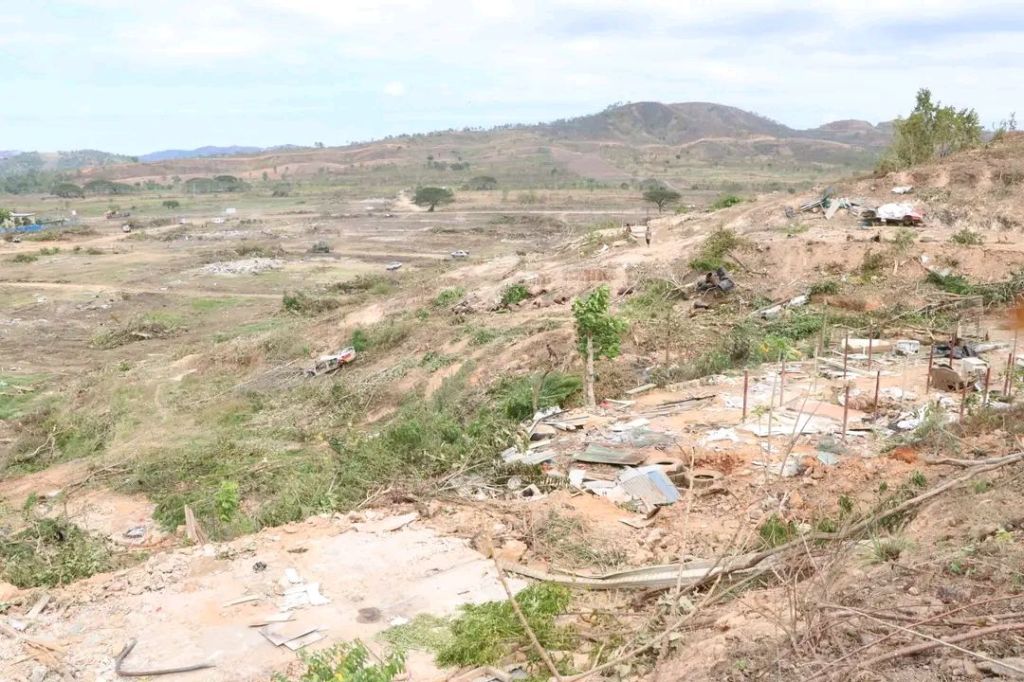
Breaking News: Mass Evictions Displace Hundreds in Port Moresby Port Moresby, [16/11/2024] – A wave of forced evictions has displaced hundreds of residents in Port Moresby, sparking widespread condemnation and raising concerns about human rights and urban planning.
Personal Thoughts on Eviction in Port Moresby
The evictions, carried out by [NCDC or lands department], have targeted several informal settlements across the city, including [Talai, Gorobe, ATS, etc]. Residents claim they received little to no notice before their homes were demolished. [The spokesman said: These people have been settling in this area for generation] While authorities justify the evictions, citing reasons such as illegal settlement, public health concerns, or infrastructure development, critics argue that the forceful removal of vulnerable communities is inhumane and lacks adequate resettlement plans. Human rights groups and community organizations have called for a more compassionate approach, urging authorities to provide support services and alternative housing options for the displaced residents. The evictions highlight the broader issue of affordable housing and urban planning in Port Moresby. As the city continues to grow, it is crucial to find sustainable solutions that balance development with the rights and well-being of all residents.
Demolished house Demolished photos of settlement Houses been destroyed Capture of demolished houses Eviction photos
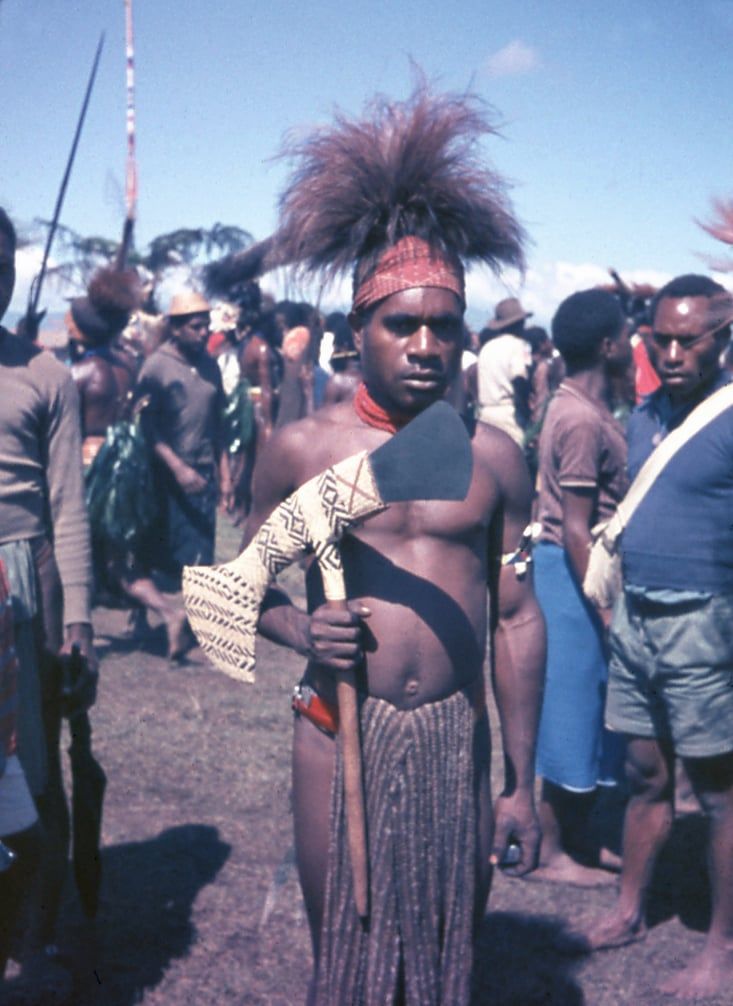
The independence of Papua New Guinea on September 16, 1975, marked a significant milestone in the nation’s history. This event was the culmination of decades of struggle for self-determination, influenced by various factors, including World War II, the rise of nationalism, and the changing political landscape of the region.
Pre-Independence Era:
* Colonial Rule: Papua New Guinea had been under colonial rule since 1884, initially divided between Germany and Britain. After World War I, Australia assumed control over both territories.
* World War II: The war had a profound impact on the country, as it exposed the vulnerabilities of colonial rule and fostered a sense of unity among the diverse population.
* Post-War Developments: Following the war, Australia implemented policies to modernize Papua New Guinea and prepare it for self-government. This included the establishment of educational institutions, development of infrastructure, and the gradual transfer of power to local leaders.
The Road to Independence:
* Self-Government: In 1973, Papua New Guinea achieved internal self-government, granting it control over most domestic affairs while maintaining external ties with Australia.
* Independence Referendum: A referendum was held in 1975 to determine whether the people of Papua New Guinea desired independence. The overwhelming majority voted in favor, paving the way for a formal declaration.
Independence Day:
* Ceremony: On September 16, 1975, a grand ceremony was held in Port Moresby to mark the nation’s independence. The event was attended by dignitaries from around the world, including Australian Prime Minister Gough Whitlam.
* Raising of the Flag: The Papua New Guinea flag was raised for the first time, symbolizing the country’s sovereignty.
* National Anthem: The national anthem, “O Arise,” was sung, expressing the nation’s pride and hope for the future.
* Speeches: Leaders from Papua New Guinea and Australia delivered speeches, emphasizing the significance of the occasion and the challenges ahead.
* Celebrations: The day was marked by festivities throughout the country, including parades, cultural performances, and community gatherings.
Significance of Independence:
* Self-Determination: Independence granted Papua New Guinea the right to govern itself, free from foreign control.
* National Identity: The event fostered a sense of national unity and pride among the diverse population.
* Economic Development: Independence provided an opportunity for Papua New Guinea to pursue its own economic development path.
* International Relations: The nation joined the international community as an independent sovereign state, establishing diplomatic relations with other countries.
The independence of Papua New Guinea on September 16, 1975, was a momentous occasion that marked the beginning of a new era for the nation. It was a culmination of decades of struggle and a testament to the resilience and determination of the people of Papua New Guinea.























 Mars Media