
Abstract
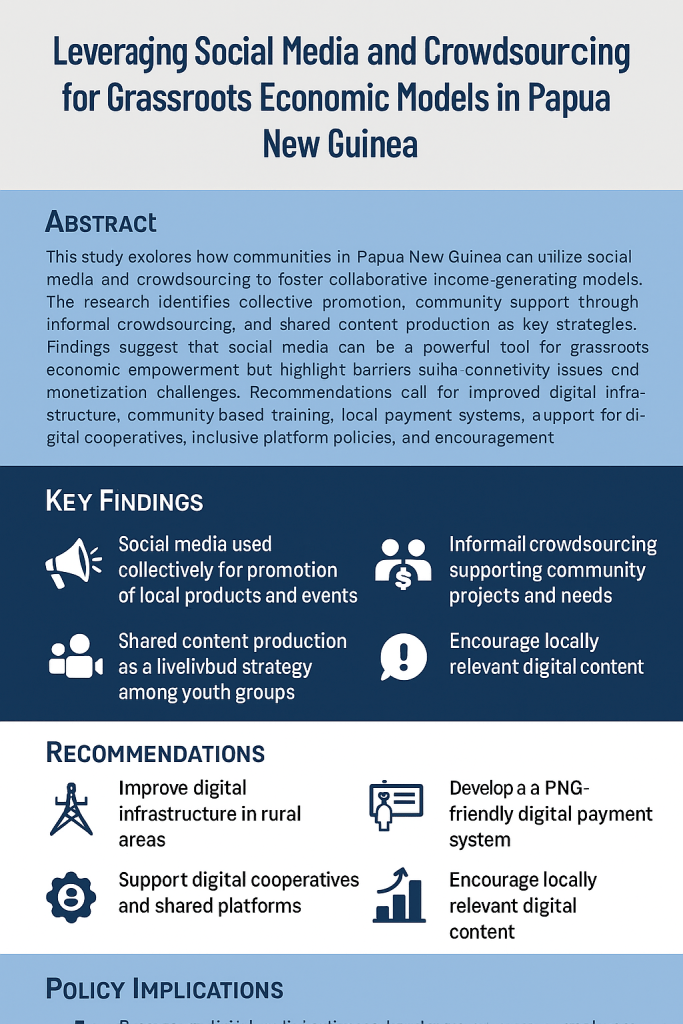
This research explores how communities in developing countries like Papua New Guinea (PNG) can leverage social media and crowdsourcing as tools for building sustainable grassroots economic models. The paper investigates how collective digital labor, facilitated through platforms such as Facebook, TikTok, and YouTube, can enable local income generation and social innovation. Drawing on qualitative data, the study applies theoretical frameworks such as the Bottom of the Pyramid (BoP), Social Capital Theory, and Platform Economy Theory to examine the interplay between community collaboration and digital participation. The findings indicate that when individuals combine their digital efforts and skills within a community-centered framework, they can amplify their online presence and economic impact. The paper concludes by offering policy recommendations aimed at fostering inclusive digital economies in PNG and similar contexts.
Keywords: Papua New Guinea, social media, crowdsourcing, grassroots economy, digital inclusion, collective digital labor, platform economy, economic development
Introduction
As digital technology continues to shape global economic landscapes, developing nations like Papua New Guinea (PNG) are presented with both opportunities and challenges. While much attention has been given to formal sectors and infrastructure-based development, grassroots communities in PNG are increasingly finding ways to engage with digital tools—particularly social media platforms and crowdsourcing networks—as means of economic participation. These platforms offer accessible, low-barrier environments where individuals can showcase talents, mobilize collective efforts, and generate income.
Papua New Guinea presents a unique case study due to its rich cultural diversity, strong communal traditions, and growing digital penetration despite infrastructural limitations. In rural areas, traditional economic models often struggle to generate sustainable livelihoods, but social media has opened up new channels for creativity, entrepreneurship, and collaboration. This paper explores how these communities utilize collective digital labor and social networks to generate income and build economic models rooted in grassroots collaboration.
The central hypothesis of this research is that communities in PNG can strategically harness digital tools to overcome geographic, financial, and systemic barriers to economic participation. By investigating these grassroots strategies, the research contributes to the broader discourse on inclusive digital economies in the Global South (World Bank, 2020).
Literature Review
Existing literature on digital economies in developing countries highlights the transformative potential of information and communication technologies (ICTs). Prahalad (2005) argues that the Bottom of the Pyramid (BoP) segment represents a fertile ground for innovation, entrepreneurship, and scalable business solutions that can address poverty. BoP theory posits that low-income populations are not passive recipients of aid but active economic agents who can innovate when given the right tools and market access.
In parallel, sociologists such as Putnam (2000) and Bourdieu (1986) emphasize the role of social capital in facilitating collective action and community resilience. Social capital—the networks of relationships, shared norms, and trust that bind communities—has been shown to enhance cooperation and economic outcomes, especially in settings where formal institutions are weak.
Research on crowdsourcing indicates that decentralized, collective labor can generate meaningful outcomes, particularly when aligned with shared community values (Howe, 2006). Crowdsourcing not only allows for the pooling of ideas and labor but also democratizes participation in economic and social projects. However, critiques from platform economy theorists like Srnicek (2017) caution that digital platforms often replicate global inequalities, limiting opportunities for those in the Global South. These platforms are designed to extract data and labor from users, often with little regard for equitable compensation or access.
Nevertheless, literature also highlights that users in underrepresented regions often develop “creative resistance”—tactics to navigate, adapt, and subvert platform limitations. This paper aims to bridge these perspectives by focusing on how communities in PNG are negotiating these dynamics through localized, collective engagement.
Theoretical Framework
The study draws on three complementary theories to frame its analysis:
- Bottom of the Pyramid (BoP) Theory – Developed by C.K. Prahalad, this theory emphasizes the economic potential of low-income communities. It advocates for innovative business models that engage the poor not just as consumers, but as entrepreneurs, producers, and collaborators.
- Social Capital Theory – As articulated by Putnam and Bourdieu, this theory explains how networks of trust, norms, and social ties influence cooperation. In PNG, where communal living and the wantok system dominate, social capital is a major determinant of collective economic behavior.
- Platform Economy Theory – This theory examines how digital platforms operate as intermediaries between producers and consumers. It critiques the exploitative structures of platform capitalism and highlights the risks of dependency on corporate-controlled ecosystems (Srnicek, 2017).
Together, these frameworks offer a lens through which to understand how grassroots communities are adapting digital tools to local realities and collective goals.
Methodology
This research employed a qualitative, exploratory approach to understand the role of social media and crowdsourcing in grassroots economic development in PNG. Given the contextual complexity and the exploratory nature of the topic, qualitative methods allowed for in-depth insights into participant experiences, motivations, and challenges.
Data were collected through semi-structured interviews with 20 individuals across five provinces in PNG who were involved in digital content creation, online fundraising, or social media-based small enterprises. Additional data sources included observations of online community pages, participatory content, and analysis of relevant public digital posts on platforms like Facebook, TikTok, and YouTube.
Participants were selected using purposive sampling to ensure a diverse representation of age, gender, geography, and digital activity level. Interviews were transcribed and thematically coded using NVivo software. Ethical considerations were observed, including informed consent, confidentiality, and respect for local cultural norms.
Findings/Results
The study identified several key themes across participant narratives and digital activities:
- Digital Collaboration: Many participants operated in teams, sharing equipment like smartphones and editing tools to create videos, manage pages, and post content. These digital collectives often formed organically through social ties and shared interests.
- Monetization through Community Support: Direct monetization via platforms was limited due to infrastructure and policy barriers, but many participants received donations, local sponsorships, or sales through peer-to-peer interactions.
- Use of Wantok Networks Online: Offline social systems extended into digital spaces. Wantoks frequently liked, shared, and promoted each other’s content, creating a virtuous cycle of support.
- Challenges in Infrastructure and Payments: Limited internet access, data costs, and the absence of compatible digital payment systems were significant barriers. Participants also expressed frustration with content moderation and visibility algorithms that favored users from high-income regions.
Despite these challenges, participants expressed optimism and described digital engagement as a pathway to both individual and collective empowerment.
Discussion
The findings of this study demonstrate that social media and crowdsourcing when approached through collective action, offer promising avenues for grassroots economic empowerment in PNG.
1. Reinterpreting the BoP in PNG’s Context Unlike traditional BoP models that focus on product delivery to the poor, the PNG context involves co-creation, where communities are not passive recipients but active producers of content, culture, and value. Digital tools enable marginalized groups to participate in a more dynamic and reciprocal economic system.
2. Social Capital as a Digital Lever The strength of PNG’s communal traditions translates into digital environments. Trust, reciprocity, and mutual aid remain central. These social values enhance the sustainability of online initiatives and allow communities to overcome resource constraints.
3. Navigating the Platform Economy While platforms impose structural inequalities, PNG communities exhibit creative resistance by forming local networks, reusing content, and prioritizing mutual growth over individual gain. This form of digital solidarity offers a compelling model of resilience and adaptability.
Conclusion
This study shows that social media and crowdsourcing can be harnessed to build grassroots economic models in PNG, especially when grounded in collective effort and local culture. Despite limited infrastructure and platform barriers, communities are finding innovative ways to collaborate and generate income. These grassroots models challenge dominant narratives about digital exclusion and highlight the agency and creativity of people at the margins of the global digital economy.
Recognizing and supporting these efforts can lead to more inclusive and sustainable digital economies in the Global South. Future research should further explore gender dynamics, long-term impact, and platform-specific strategies in other regions of PNG.
Recommendations
- Improve Digital Infrastructure: Expand rural internet access and subsidized connectivity.
- Community-Based Digital Training: Offer localized training in digital content, entrepreneurship, and security.
- Local Digital Payment Systems: Integrate mobile wallets with global monetization tools.
- Support Digital Cooperatives: Provide grants and legal recognition to digital teams.
- Platform Policy Advocacy: Advocate for inclusive rules and representation on major platforms.
- Encourage Local Content: Invest in cultural and educational content creation programs.
Policy Implications
- Recognize digital inclusion as a development priority.
- Adapt economic policy to include informal digital innovators.
- Reform financial systems to support digital income flows.
- Build regional advocacy alliances to engage platform providers.
- Design development initiatives that respect and integrate local social capital.
References Bourdieu, P. (1986). The forms of capital. In J. Richardson (Ed.), Handbook of theory and research for the sociology of education (pp. 241–258). Greenwood.
Prahalad, C. K. (2005). The fortune at the bottom of the pyramid: Eradicating poverty through profits. Wharton School Publishing.
Putnam, R. D. (2000). Bowling alone: The collapse and revival of American community. Simon & Schuster.
Srnicek, N. (2017). Platform capitalism. Polity Press.
World Bank. (2020). Papua New Guinea digital economy diagnostic. https://documents.worldbank.org/en/publication/documents-reports/documentdetail/879161593372710838/papua-new-guinea-digital-economy-diagnostic
 Mars Media