
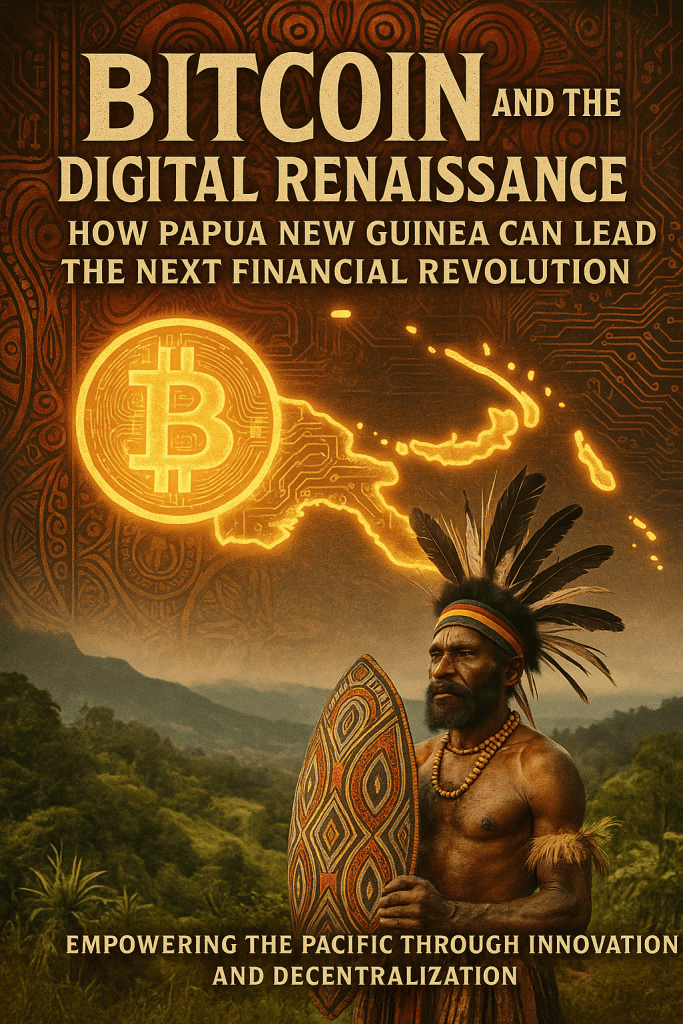
Papua New Guinea (PNG) stands at a pivotal juncture in its economic evolution. The global shift towards digital assets, particularly Bitcoin, offers PNG an opportunity to enhance financial inclusion, stabilize its economy, and integrate into the burgeoning digital economy. This comprehensive overview delves into the historical context of cryptocurrencies, the technological advancements, governance models, and the potential benefits for PNG.
I. Historical Context of Cryptocurrency: From Concept to Reality
Early Foundations
The conceptual underpinnings of digital currencies trace back to the 1980s and 1990s with the emergence of ideas like David Chaum’s DigiCash and Wei Dai’s b-money. These initiatives aimed to create secure, anonymous digital payment systems but lacked the technological framework to prevent issues like double-spending.
The Emergence of Bitcoin
In 2008, an individual or group under the pseudonym Satoshi Nakamoto published the Bitcoin whitepaper, introducing a decentralized digital currency that operates without a central authority. The Bitcoin network commenced in January 2009 with the mining of the genesis block, embedding a message referencing the financial crisis: “The Times 03/Jan/2009 Chancellor on brink of second bailout for banks.” This highlighted Bitcoin’s intent to offer an alternative to traditional financial systems .
Evolution of Blockchain Platforms
Building upon Bitcoin’s foundation, Ethereum was proposed by Vitalik Buterin in 2013 and launched in 2015. Ethereum introduced smart contracts, enabling decentralized applications (dApps) beyond mere financial transactions . Other platforms like Solana have since emerged, focusing on scalability and speed to support a wide array of decentralized services.
II. Bitcoin’s Economic Framework: Tokenomics and Governance
Supply and Distribution
Bitcoin’s supply is capped at 21 million coins, with approximately 19.5 million already mined as of early 2024. The issuance rate halves every 210,000 blocks, roughly every four years, to control inflation .
Governance Model
Bitcoin operates as a decentralized autonomous organization (DAO), where changes are proposed through Bitcoin Improvement Proposals (BIPs). Consensus is achieved via community discussions, miner signaling, and user-activated soft forks, ensuring that no single entity controls the network .
III. Global Adoption and Institutional Recognition
Governmental Engagement
In March 2025, U.S. President Donald Trump signed an executive order to establish a strategic Bitcoin reserve, signaling a significant governmental endorsement of cryptocurrency .
Corporate and Institutional Investment
Major corporations and financial institutions have integrated Bitcoin into their portfolios. For instance, BlackRock recommended allocating up to 2% of investment portfolios to Bitcoin, reflecting growing institutional confidence in digital assets .
IV. User-Centric Innovations: The Case of Pi Network
Pi Network represents a shift towards accessible cryptocurrency mining, allowing users to mine coins via mobile devices without extensive technical knowledge or significant energy consumption. This model democratizes access to digital assets, particularly benefiting individuals in regions with limited technological infrastructure.
Educational and Financial Empowerment
By engaging with Pi Network, users gain exposure to blockchain technology and digital finance, fostering financial literacy and digital skills. This is particularly impactful for youth and unbanked populations in developing regions, providing them with tools to participate in the digital economy .
V. Strategic Implications for Papua New Guinea
Enhancing Financial Inclusion
With a significant portion of PNG’s population lacking access to traditional banking services, cryptocurrencies offer an alternative means for financial transactions, savings, and investments, promoting greater economic participation.
Economic Diversification and Stability
Integrating Bitcoin into national reserves can serve as a hedge against inflation and currency volatility, providing economic stability. Furthermore, embracing blockchain technology can diversify PNG’s economy, fostering innovation and attracting foreign investment.
Empowering Rural Communities
User-friendly platforms like Pi Network can empower rural populations by providing access to digital financial tools, facilitating entrepreneurship, and enabling participation in the global digital economy without the need for traditional banking infrastructure.
Conclusion
The global trajectory towards digital currencies presents Papua New Guinea with an opportunity to enhance financial inclusion, stabilize its economy, and integrate into the digital economy. By adopting cryptocurrencies and blockchain technology, PNG can empower its citizens, particularly those in rural and unbanked regions, fostering economic growth and resilience in the digital age.
 Mars Media